 |
The FBI versus Apple: A Catch-22
We knew this would probably happen sometime – a court fight
over smartphone security issues. Sure
enough, the FBI is hard at it with Apple.
The terrorists in San Bernardino, California, back in December were
using an iPhone. The FBI wants Apple to
hack the phone and Apple is saying no.
That would compromise one of the main features of those phones and set a
most unfortunate precedent. However, law
enforcement officials of all kinds are anxious for resolution because all kinds
of criminals use smartphones, which at present can be “tapped” only with great
legal and technical difficulty.
We do think this issue is worthy of discussion. It’s obviously controversial for Apple to
even have objected at this point in time, since the immediate cause is a
domestic terrorist attack in which 14 people were killed. And it’s easy to say, “but of course Apple
should provide the mechanism for opening the phone’s contents.” But Tim Cook, the CEO of Apple, does have a
point that this is precedent-setting and the way to deal with it should be
discussed openly.
6 Weeks' Worth of Data Locked in the Phone
This San Bernardino event is a great test-case. iPhones are secure to the owner/user. They can be backed up to a storage area on a
“cloud”. Data that are transferred to
the cloud can be obtained by investigators, and indeed, the FBI has already
obtained those data from terrorist Syed Rizwan Farook’s account. However, the attack took place on December 2,
and Farook had not backed up the phone since October 19. So plenty of fresh and helpful information
was likely recorded on the phone during the last six weeks just before the
attack: who Farook’s associates and ISIS connections might be, whether other
projects similar to his are being planned, and so on. The phone itself is owned by San Bernardino
County, which employed Farook; those officials, the owners, think it’s fine for
the FBI to inspect the phone’s contents.
But Apple Worries about Construction of a "Backdoor"
Apple, through a public statement by its Chairman Tim Cook
and also in an official court filing, is objecting to unlocking the phone. The company argues that the work it would do
to enable decryption of the contents of an iPhone could be applied to any
iPhone, thereby potentially eroding the extraordinary security provisions on
all iPhones. As it stands, the data on
any given iPhone are associated with the owner’s “Unique ID”. The FBI is wanting Apple to devise a
workaround to get to the data without the ID.
This is known in the jargon as a “backdoor”. Apple is, quite logically, very concerned
about creating such a backdoor technology.
Conceivably, then, any iPhone a thief or other criminal got hold of
could be hacked.
We were watching a Fox News program late last week in which
a retired Army colonel was being interviewed on this issue. The colonel said something like, “this is a
national security issue and of course Apple needs to develop this decryption
software!” The news anchor conducting
the interview instantly blurted out, “but that’s why I have an iPhone –
precisely because it can’t be
decrypted by anyone else.”
FBI Does See the Importance of the Phone's Security
FBI Director James Comey initially sounded impatient with Apple,
claiming that Apple’s defense, spontaneously described by the anchor in that
newscast, is based on marketing and reputation, not on the technology. Apple and many of its customers would not
agree; the security of the phone is a basic characteristic of the product. Given that there are in fact some 825 million iPhones around the world, their interests would seem a worthy consideration. And evidently, Mr. Comey himself
has come to a deeper understanding of what he was asking of Apple. Later, on February 25, he testified before
the House Intelligence Committee that this encryption issue is “the hardest
question I’ve seen in government.”[1]
Addressing the Law Enforcement Need Now
There is legal precedent, of course, for telecommunications
companies to provide call data to law enforcement agencies. In 1994, Congress passed the Communications
Assistance for Law Enforcement Act which requires carriers to build
surveillance capability into their networks.[2]
So AT&T and Verizon automatically provide whatever such “wiretap”
access is called for in court orders; in the last half of 2015, there were more
than a quarter million such requests from all kinds of law enforcement agencies
in both criminal and civil proceedings.
In the first half of last year, 998 requests came specifically for
national security purposes. Sprint also
has had many thousands of such data requests.
Apple in fact does address these requests too. It reports that it had 971 law enforcement
requests for “account data” stored on iCloud or iTunes accounts in the first
half of last year, and it responded to 81% of them. In addition, it had 499 requests based on
national security needs.
The difference is evidently that the information the
carriers provide is only phone numbers and text message connections. According to The Wall Street Journal, it
“can’t provide access to . . . message content or calls made over mobile apps
such as WhatsApp, Skype or the blue iMessages sent between two iPhones.[3]
Formal Legislation Likely Needed
Regardless of the specific outcome of the San Bernardino
case itself, it is likely to add to already building momentum for formal
legislation on this situation; that is, there should be some general rules so
people who own phones can know what to expect, and representatives of the
people should make those rules. Indeed,
the Chairman of AT&T Randall Stephenson this week noted, “The rapid pace of
technological innovation is challenging laws crafted in a very different era
for totally different, and much less complex situations. Recent developments, in particular, bring
home the need for legal clarity.” And
the Chair of the Senate Intelligence Committee is working on a bill that would
create criminal penalties for companies that don’t comply with court orders to
decipher encrypted communications. It
remains to be seen what the specific language of such a law might require.[4]
So, most immediately, the dilemma remains. More, in the San Bernardino situation, there
is considerable irony. We noted that the
county government owns the phone; Farook was only the user of that phone. That government is in possession of software called
“mobile device management” that would have enabled the county to make provision
for the FBI to open the phone. But Farook’s
department did not sign up for it to be installed on their inspectors’ phones.[5] Another irony is that, even as the federal
government is fighting for the right to get Farook’s phone decrypted, the
federal government provides grants to tech developers to create more encryption
software.[6]
A clear summation of this Catch-22 was given last spring by
a former CEO of Sprint at a cybersecurity conference: “Which CEO is more
patriotic, the one who provides all the information the government requests to
help catch a criminal or prevent a terrorist attack? Or the CEO whose company creates tools that
make it difficult for law enforcement . . .
to acquire a customer’s information, believing that protecting civil
liberties is a higher calling?”[7]
+ + + + + +
We don’t cite all the general
sources about this story, which are plentiful; most of our material is from
various articles in The Wall Street Journal, beginning right after the federal
court order to Apple was made public on February 16. We also sourced The Economist magazine and www.foxnews.com, as well as Apple CEO Chairman Tim Cook's "A Message to Our Customers", a letter dated February 16 and found on Apple's homepage at www.apple.com.
The footnotes cover specific
aspects and quotes.
[7] Ryan Knutson. Op. cit.
Labels: American Society, Government Policies, Science and Evolution
Earth Day and the Industrial Revolution in 3 Graphs
It's Earth
Day. Or it was three days ago. But what we write is still relevant to the
season. In any event, why would we begin
with a picture of world population growth?
Well, the number of people on Earth should have an obvious connection to
Earth Day. But the key to the immediate connection
we want to highlight is the blue line in the graph showing the beginning of the
Industrial Revolution. A neighbor of
mine, a gentleman who's fairly in-the-know about economic issues, stopped me on
the street the other day to ask if I understood how much difference the
Industrial Revolution made to the world's population. He had just learned this, he explained, in an
online course he had taken, and he was stunned.
So I figure if Steve is stunned, maybe some of you are too. So here's some of the story and why we pay
particular attention on Earth Day. It's
not just the numbers of people, but their standards of living that matter.

The key is
the bend in line. The world's
population was basically flat from the year 1 A.D. to 500 A.D. at about 200
million people; estimates show that by 1000 A.D., it was still no more than
250-300 million. Population reached
about 500 million by 1500 and 1 billion in 1800. Now, just 215 years later, there are about
7.2 billion people. The addition of the
last half of that, 3.6 billion, has taken only 45 years. So clearly some very dramatic things happened
around and after 1800.
We often
think of the Industrial Revolution in terms of the cotton gin and other
machinery, but advances in health care and public facilities are also
important. As examples, Edward Jenner's
small pox vaccine came in 1798. John
Wilkinson, an Englishman, developed the iron pipe that made a new water supply
system in Paris in 1786. John Snow realized in 1854 that contaminated
water could contribute to the spread of cholera. Before this period, life expectancy at birth
hovered around 24 years in the medieval period and got to 35 in England by the
mid-18th Century. By 1900, it
reached the late-40s and was about 80 years in 2010. In other words, death rates declined
markedly. This is so all over the world.
At the same
time, birth rates have also declined.
This latter factor has been pronounced enough that population growth
rates have actually moderated in recent decades. Big as the numbers are, they are no longer
accelerating.
Robert
Lucas, a consulting economist to the Minneapolis Federal Reserve Bank, has
written about these birth and death rate trends. As the Industrial Revolution took place,
along with accompanying gains in agricultural output and the improvements to
health, population did expand dramatically.
The gains in production supported the population growth. Thomas Malthus and other economists of his
day – around 1800 – began to fear that this population growth trend would
consume much of the earth's resources, leading to increased poverty. While there is quite justified concern over
that eventuality, Lucas offers some mitigating notions.
At the
outset of the industrial and agricultural revolutions during the 18th
Century, most of society was agricultural, and as farmers obtained larger
yields for their crops and had healthier animals, they used their increased
income to enlarge their families, so they could produce bigger crops still. Living standards – income per person – thus
didn't change much at first. From 1700
to 1820, world GDP firmed from 0.2% growth per year to about 0.5%. But population had almost the same movement,
so each person was associated with about $665 worth of output in 1820, only mildly
larger than the $596 in 1600.
But starting
around 1820, that relationship shifted.
Those health improvements we mentioned before, clean water and similar improvements
to sewage disposal, made conditions much better in cities and people began
moving to them and doing more industrial work.
This coincided with diminishing birth rates, enough so that total production
gains were associated with more production per person; by 1900, that had nearly
doubled to $1,260. By 2008, the latest
year for which we have this specific calculation, world output per person was
just over $7,600, as seen here.

We're
writing about all this because it's Earth Day.
What is the connection? As the
line in the above graph was moving definitively higher in the early 1960s, a
marine biologist named Rachel Carson published Silent Spring, a book that grabbed everyone's attention about how
more people were using more of the earth's resources, much of that in an
ironically unhealthy way. For the first
time, many people came to understand that they could not just plow ahead
unconcerned about what they were doing to the earth and its environment. Would this new realization slow growth?
It took some
time, but progress in making the right use of the earth is taking place. Robert Lucas, in the material we reference
here, counters some environmental naysayers' arguments by highlighting the role
of technology. He points out that we
should use a theory of economic growth that embodies not just numbers of people
and amounts of consumption, but the application of technology, ingenuity and
adaptability.
This notion
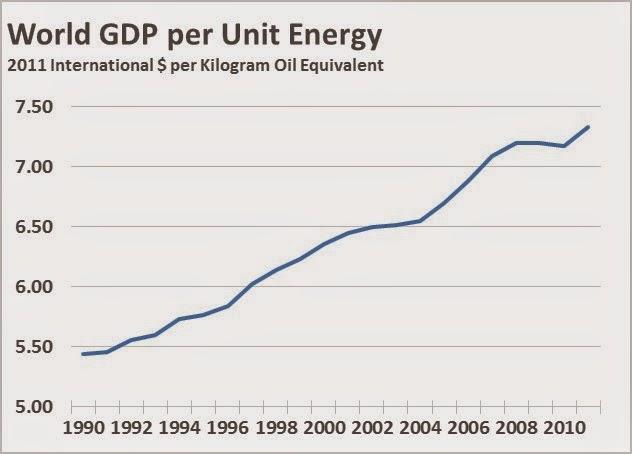
prompted us to check out the amount of energy used in producing today's GDP compared
to some historical period. If GDP growth
just uses more and more energy resources, then the naysayers will be right;
succeeding generations of people will indeed be less well off because pure air,
clean water and all kinds of material resources will be scarcer for everyone.
What we
found with some brief searching, is just 20 years' worth of information on
this. But it tells a positive, hopeful
story. Data from the World Bank show
that a fixed unit of energy would yield $5.40 of world GDP in 1990. By 2010, the same amount of energy made $7.20
of GDP.
Further, in
1990, each dollar of GDP was associated with 0.5 kilogram of carbon emissions,
but in 2010, this had fallen to 0.4 kilogram.
Energy use per person has increased for the world as a whole, but this
is happening in middle income regions in Asia, the Middle East and northern
Africa, not in high income regions. In
fact, in many places per capita energy use has gone down; in the U.S., for
example, each person used 7,700 kilograms of energy in 1990, but just over
7,000 kilograms in 2011.
So perhaps Lucas
is correct. If we know and understand a
situation, we can quite probably find ways to deal with it. Thus, growth can continue to the extent that
we become more efficient in using energy, and we can even develop new energy
sources and/or improve the way we manage current sources. We can further reduce pollution without
severely restricting our general ways of life.
This isn't automatic, and we have to be mindful and deliberate in our
efforts, but we have a good shot at continuing to improve our lives and the
life of the Earth itself.
--------------------------------
Sources:
Long-term
historical data on population and world GDP are based on Angus Maddison, The
World Economy: A Millennial Perspective.
Paris, France: Organisation for Economic Co-operation and Development. 2001 and 2006. http://www.oecd-ilibrary.org/development/the-world-economy_9789264022621-en. A pdf may be purchased or the book may be
read in an e-book format on that site.
Barnes & Noble and Amazon also have it available.
Maddison was
professor at the University of Groningen from 1978 to 1997 and a founder of the
Groningen Growth and Development Centre. He passed away in 2010. His data are recognized as the primary
compilation of long-term world-wide GDP and other economic and demographic
indicators; they are now maintained and made available in spreadsheets on a
site managed by his colleagues at that research center http://www.ggdc.net/maddison/oriindex.htm.
Data on the
relationship of energy to GDP, energy use per person and carbon emissions come
from the World Bank's World Development Indicators. The 2015 edition of these was published just
on April 14, 2015, and includes these energy data through 2011. See http://wdi.worldbank.org/table/3.6
"Energy production and use" and http://wdi.worldbank.org/table/3.8
"Energy dependency, efficiency and carbon dioxide emissions". Accessed April 24, 2015.
Labels: Economy, Environment, Science and Evolution, World
Fracking and Methane: Response to a Comment
In a Comment to the "Follow-up on Fracking" post
below, Reader Chris Johnson calls us to task for not mentioning the methane
issue. This Reader Chris is quite
right. It is an important
consideration. If fracked gas wells
and/or pipes have leaks, methane will escape.
Methane is the main chemical component of "natural gas". It has
good uses in making fabric, plastics, anti-freeze and fertilizer, among others. But if it leaks uncontrolled into the
atmosphere, it acts as a greenhouse gas that is at least as harmful as carbon
dioxide. Recent academic research, cited
by our favorite author on these topics, Russell Gold, in a February Wall
Street Journal blog article, suggests that methane emissions are quite
sizable. Indeed, he describes that using
natural gas as fuel for transportation in cars and trucks, because it can leak out, may not be any better
for the climate than regular gasoline.
However, in the confined space of a power plant producing electricity or
a home producing heat, natural gas does have significant net benefits over coal
and fuel oil.
Another important point is one we alluded to in our original
article. Building the fracking wells
themselves and then transporting the gas must be done carefully. If the cement shell of the well cracks,
methane will escape. Notably, the leakage of
methane does not come from the inherent design of the fracking wells, but
rather from flaws in the materials and construction of wells and pipeline. These can be fixed by the oil companies, or better yet, prevented
by careful construction in the first place.
All this underscores our basic conclusion yet again. Use less energy to begin with. But we can use natural gas quite effectively
in electricity plants and furnaces, as long as the gas is obtained through safe
fracking practices. This is important to
know.
Labels: Environment, Industry, Science and Evolution, World
Some Follow-Up on Fracking
In response to our Earth Day article on fracking, three
helpful readers posed questions about natural gas and fracking or gave us
additional information resources. This
topic is a hot one and press reports and journals present new material nearly
every day. To wit:
1. Reader Chris wants
to know what difference fracking has made in US production of petroleum and
natural gas. In other words, is it such
a big deal in our overall energy supply situation?
The answer is "plenty" of difference.
See this graph of production data from the Department of
Energy's Energy Information Administration (shaded areas are recession periods).
This includes crude oil, natural gas, coal, nuclear,
hydroelectric and other renewables; you can see the upturn in 2007, a pause
during the Great Recession and since then a sharp uptrend. Earlier years had seen at best a flat pattern
in these production numbers, with crude oil in particular falling
consistently.
Now, if we are producing more of our own energy, are we then
using more energy? Well, no. What our increased production has meant is a
pronounced decline in imports, as visible here:
In fact, the amounts imported during 2013 have returned to
1997 levels. So the new production from
fracking has already eased our dependence on foreign energy producers.
2. Our article
mentioned the potential for exporting fuels.
Reader Carolyn wants to know how it might work to export natural
gas. There are two aspects to the reply,
one physical and the other regulatory.
From the physical standpoint, it obviously sounds
impractical to ship natural gas in ships across oceans, doesn't it? A quick Google on "how to export natural
gas" brings us to a whole discussion by Shell Oil Company, which in fact does
just that around various parts of the world.
They do it by chilling the gas into a liquid form; there are liquefaction
plants in seaport cities and gas arrives at those plants via pipeline. The gas is super-cooled to -260 degrees
Fahrenheit (-162 degrees Celsius); this shrinks the volume some 600 times and
produces a clear, toxin-free liquid, known as liquefied natural gas or LNG,
which is easily shipped in tankers. At
the receiving end, it is heated at "regasification" plants and sent
off in pipelines to final users. The
U.S. has imported lots of natural gas this way for decades. [Source: http://www.shell.com/global/future-energy/natural-gas/liquefied-natural-gas/what-is-lng.html]
Now, the reverse is happening in
the U.S. Several liquefaction plants for
exporting are either in the planning or construction stages in Louisiana,
Texas, Maryland and Oregon. But there is
an important regulatory constraint:
according to a recent USA Today article, exporting natural
gas requires a "public interest" ruling from the Energy Department if
the buyers are located in countries where we do not have a free trade
agreement. So shipping to Europe, China,
India and Japan, among others, must undergo extra regulatory processes. Altogether, 31 plants have applied for this
approval and the ones just mentioned have received at least a conditional OK. One in Louisiana, owned by Cheniere Energy,
is in final construction stages and should open next year. [Source: http://www.usatoday.com/story/news/nation/2014/04/07/us-natural-gas-exports-to-begin/7204925/]
3. Reader Mary, who lives in Colorado, calls our
attention to a very informative website, www.studyfracking.com. While the material is geared specifically to
Colorado, much of the information is general and is accompanied by extremely
helpful diagrams and pictures. For
instance, one of the diagrams is a cross-section showing how much farther below
ground fracking occurs, compared with the location of groundwater. Mary's own comments highlight one of the benefits
of fracking that we also mention, the good jobs the drilling industry provides
that can help people move up and succeed economically.
4. We can elaborate on a couple of other points
in our article. One, we referred briefly
to earthquakes that might be caused by fracking. The U.S. Geological Survey announced last
week that it plans to map "manmade earthquakes" in more detail, since
the rate of seismic activity has increased in the last few years when fracking
has been taking place. The earthquakes
are small, with Richter Scale magnitudes of around 3.0, but there are more of
them. Notably, the quaking seems to
result from disposal of the wastewater used in the fracking, not from the
fracking itself. So all this bears keeping
up with. Source: [ http://online.wsj.com/news/articles/SB10001424052702303948104579535991486675268]
Two, we can point out that our
general concluding mandate, "use less energy!" need not mean we have
to feel deprived. Here is a picture of a
new BMW vehicle, the i8, which will be on sale in the U.S. in the fall. It is a plug-In hybrid made of carbon-fiber
reinforced plastic; this material is as strong as steel and weighs markedly
less, more than offsetting the added weight of the necessary lithium-ion
batteries. While carbon fiber has been
used in cars before, such as Lamborghinis and McLarens, this is the first
adaptation of mass production for a carbon fiber body shell. This sports car goes from 0 to 60 mph in 4.2
seconds, the same as a Porsche 911, but its gas mileage is 50-60 mpg, similar
to a Toyota Prius. Now, we won't all
want to buy one; the price will evidently be something like $135,700.
Labels: Environment, Industry, Science and Evolution, World
Wetlands, GMOs and Rogation Day Prayers
Last week on Earth Day, we spoke of Nature's Fortune and how
businesses are prospering by making investments that enhance Nature and the
environment instead of eroding them. At
the end, we made casual mention of two items that are worth more attention: built
wetlands and GMOs. There is actually a
suitable church-calendar occasion for this further commentary on Nature, the
upcoming Rogation Sunday and Rogation Days.
The Sunday is observed on the 6 th Sunday of Easter in the
Episcopal Church calendar and the Days are the following Monday, Tuesday and
Wednesday immediately before Ascension Thursday; the petition is for blessing
of crops as they are planted and for the stewardship of creation.
Ways of the World has offered prayers before at this time of
year, especially since our current Prayer Book commemorates industry as well as
agriculture in the prayers it presents.
This year, as we googled a bit on "Rogation" – it means "asking",
as in "interrogation" – we came across commentaries from priests in rural
settings in Alabama and in Wyoming who worry about this shift in emphasis away
from agriculture and nature, fearing that it will lure people away from their
role as stewards of Nature.
Perhaps. But as our own current lessons
are teaching, we now see that we can use this occasion as a catalyst for talking
about both wetlands and GMOs as they clearly represent the meeting of industry
and Nature.
Why Would a Company
Build a Wetland?
In 1996, Dow Chemical was pressured by regulators to do
something about water pollution at its Seadrift, Texas, plant; a new wastewater-treatment
facility was clearly necessary.[1] The
company's engineers began the design work for a big concrete system they
estimated would cost about $40 million.
But one of them had a different idea: "build" a wetland. This would work because as wastewater flows
through such a wetland, as the EPA's website explains, "it slows down and
many of the suspended solids become trapped by vegetation and settle out. Other
pollutants are transformed to less soluble forms taken up by plants or become
inactive. Wetland plants also foster
[the development of microorganisms, which] transform and remove pollutants from
the water."[2] The Dow version at
Seadrift occupies 110 acres and treats 5 million gallons of water a day. This "green infrastructure" cost
$1.4 million, a tiny fraction of the much more involved "gray"
installation. Wildlife also like these
places, so here is one instance in which man has helped Nature along in at
least a couple of ways.
You've read and heard plenty about how big companies,
especially chemical companies like Dow, hurt the environment. This is an example of how they are evidently
coming around on this issue. The EPA
reports[3] that there are more than 1,000 constructed wetlands in the US and
5,000 altogether around the world. Dow
also has a one at Pittsburg, California, and their enormous plant at Freeport,
Texas, is becoming an experimental center for a huge project with The Nature
Conservancy. Sustainability officers at many
companies are now part of the main operational management, not just offshoots
of P.R. or public affairs departments.
As seen in the Seadrift example, the company's bottom line got big help
from the built wetland innovation, and such cost considerations are part and
parcel of these decisions. The lower
cost way was the better way.
What Good Are GMOs?
The GMO issue is trickier, since not all the science on GMOs
agrees about their safety. They have
also not been handled in the most helpful way by the companies that produce
them. Here's some of what we do
know. Genetically modified plants are
meant to help food production in three ways.
They are intended to make the plants more resistant to insects so less
insecticide is needed, they are meant to increase resistance to viruses so
plant yields are greater and they are meant to make plants more resistant to
herbicides so weeds can be killed without killing the plants themselves.[4] These are all good things. But the chemical formulas to achieve these
characteristics must be varied for each growing region according to the soil
content and the weed situation in each locale.
So GMO production and distribution are more customized, leaving farmers
and consumers more dependent on the individual companies making the seeds. This has generated a kind of monopoly
situation, with public emphasis often focused on the profits made by the
companies over and above the benefits of the GMO plants.
There is also concern over what the genetic modifications
might do to the soil and whether people might have a greater tendency to be
allergic to GMOs than to un-modified plants or to have other reactions to the
genes in the modified plants.
Information from the World Health Organization (WHO) assures that for
GMOs traded in world markets, no additional "allergenicity" is
present; they do urge caution in the use of antibiotic-resistant products in
which the modified genes might get transferred to those who consume the foods,
though WHO says chances of this are small.
In the main, the WHO experts inform us[5], plants sold in international
markets have been found safe.
So why use these if they are questionable? Because plant yields are indeed greater, and
less chemical application, such as insect-killers and weed-killers, is needed
in their production. Being able to
produce more food with less raw material will be absolutely necessary in coming
decades as the world population grows, Mark Tercek of The Nature Conservancy
points out, and all the more as people are lifted up out of poverty into more active
lives; that's one of the main reasons he wrote the book Nature's Fortune. Business and industry must invest in and be
stewards of agriculture and nature for all of us, all 7 billion of us, to grow
and prosper together.[6]
Indeed,
Almighty God, Lord of heaven and
earth: We humbly pray that your gracious providence may give and preserve to
our use the harvests of the land and of the seas, and may prosper all who labor
to gather them, that we, who are constantly receiving good things from your
hand, may always give you thanks; through Jesus Christ our Lord, who lives and
reigns with you and the Holy Spirit, one God, for ever and ever. Amen.
And
O merciful Creator, your hand is
open wide to satisfy the needs of every living creature: Make us always
thankful for your loving providence; and grant that we, remembering the account
that we must one day give, may be faithful stewards of your good gifts; through
Jesus Christ our Lord, who with you and the Holy Spirit lives and reigns, one
God, for ever and ever. Amen.
------------------------------------------------
[1] Mark R. Tercek and Jonathan S. Adams. Nature's Fortune: How Business and Society
Thrive by Investing in Nature.
New York: Basic Books. 2013. Pp.
168ff and various Dow Chemical Company reports.
See www.dow.com.
[3] Ibid. Some of the
constructed wetlands are associated with farms as well as industrial uses.
[5] Ibid.
[6] Tercek and Adams. Page 3.
Labels: Environment, Episcopal Church, Industry, Science and Evolution
Food Sustainability, Business and Earth Day
During Lent, my home parish, St. Ann & the Holy Trinity
in Brooklyn, New York, studied food sustainability. Guest preachers, a book group[1], a tour of a
museum exhibit[2] and even a cooking class conducted by two vestrymembers
taught us about honoring creation, urban farming and serving locally produced
foods. One lasting feature of these
events is Sandwich Sundays, for which parishioners make and contribute bunches
of simple sandwiches for the benefit of a homeless drop-in center elsewhere in
Brooklyn.
This year, then, these notions make a quite suitable theme
for Ways
of the World for Earth Day. It
was all new territory for this retired Wall Street economist, but as we googled
and browsed, we made a connection: investing in nature. Growing vegetables on the roof of an
apartment building and shopping for organically produced foods are important
for individuals. But to feed the world's
7 billion people, we still need the mass-production efforts of big business and
industrial agriculture. What's
important, we learned in our recent studying, is adapting mass production
methods in ways that support nature, not erode it. Business can indeed "invest in
nature" and even build "green infrastructure" in the place of
"gray infrastructure".
There is a brand new book (publication date: April 9) about
all this, Nature's Fortune: How Business and Society Thrive by Investing in
Nature, by Mark Tercek and Jonathan Adams[3]. Tercek is president and CEO of The Nature
Conservancy[4], a major nonprofit that works on land and water issues. He went there from Goldman Sachs, where he
had been an investment banker for some 24 years. The promotional endorsements on the dust
jacket thus come from such diverse personalities as Bill Clinton; Henry
Paulson, former chair of Goldman and Treasury Secretary in the Bush
Administration; and Andrew Liveris, Chair of Dow Chemical; as well as noted
biographer Walter Isaacson, who is also CEO of the Aspen Institute; and sociobiologist
E.O. Wilson. Co-author Adams is a science
writer and conservation biologist. The
book's proceeds all go to The Nature Conservancy.
Nature's Fortune covers issues of water, agriculture and
climate change. Here are two topics
concerning sustainable food production and big business.
Coke and the Water Supply in India
First, Ways of the World hasn't talked to
you about water, and we need to do that more thoroughly. For the moment, just one example. It takes a lot more than 1 liter of water to
make 1 liter of Coke. A lot more. In addition to the beverage, 1 liter is used
in producing the Coke, 10 liters in making the plastic bottle and 200 liters of
water in growing the sugar. In 1999, a
Coke bottling plant opened in the State of Kerala, India. In just five years, the water wells there
dried up and farmers were unable to irrigate their crops. While there turned out to be several reasons
for the water shortage, outcry from the local community forced the company to
close the plant. It later reopened, but
Coke and other beverage companies in India and basically everywhere else came
to understand their relations with water supplies. Coke began efforts to restore the water it
uses there and elsewhere; Coke began to "invest in nature".
Chicken McNuggets and Amazon Deforestation
Second, we also learned in Nature's Fortune about
the global importance of the Amazon rainforest.
We'd heard this concern but hadn't understood how great the stakes
are: those trees pull water up from deep
in the ground and pump it into the sky.
The forest contributes 8 trillion tons of water to the atmosphere every
year and much of that water vapor circulates around the world (page 90). So as farming has expanded in Brazil and
farmers have cut trees down, the consequences are vast. One key incident of deforestation also
involves the global reach of the food supply chains.
Among other crops, Brazilian farmers grow soybeans and
demand for them has increased greatly in recent years. Grain dealer Cargill (an American company)
built a deep-water shipping terminal on the Amazon River in 1999. There hadn't been much farming in that
specific region, but the installation of the transportation center spurred big
growth. Consequently, rates of
deforestation doubled in just four years.
Cargill buys soybeans from the farmers and sells them in particular to
farmers in the UK who raise chickens; those chickens in turn are used to
produce the Chicken McNuggets sold by McDonald's in the UK. In 2006, Greenpeace issued a report about
this, and their publicity included Ronald McDonald with a chain saw, cutting
down trees in Brazil.
McDonald's could have barked back, issuing some tirade about
Greenpeace, and then tried to go on about their business. But they realized both that the bad publicity
would only get worse and also that they really should do something about the problem
itself, in order to preserve the food supply for their own product. So they began to work with Greenpeace and
with Cargill. McDonald's and Cargill
announced they would not buy soybeans grown on land cleared after 2006 and
Cargill installed a satellite monitoring system to keep track of the origin of
the soybean shipments. Deforestation
continues, but rates have dropped back dramatically since this policy change by
the companies.
The Role of Business in Environmental Progress
Tercek points out that business is a key link in policy
chains like these. Individual farmers or
individual consumers may be hard for
policymakers and advocates to reach in sufficient numbers. But businesses are the implementing agents in
producing and distributing goods and services.
Working with them is the most effective way of effecting the desired
change. Further, it doesn't help at all
to work against businesses. "…what
if, instead of saying no, environmentalists ask 'How?'" Tercek suggests (page
166). We'll continue with more on all this
in other sectors. We have to share some
of the story, for instance, of Dow Chemical building a wetland in Texas. Yes, you read that sentence correctly. Today we talked about food and there's more
to that story too. Tercek talks
favorably about GMOs – genetically modified organisms – which many commentators
love to hate. But GMOs increase
production at a time when millions more people need to be able to get more food;
GMOs represent a technical answer to that issue and we have to figure out the
most equitable way to foster their use.
Altogether, there is progress to report on Earth Day and the ways
forward are multiplying. Now, go have a
Coke and some Chicken McNuggets and know they are produced with more care for
the Earth than ever!
--------------------------------------
[1] Sara Miles. Take
This Bread. New York: Random
House Publishing Group. 2008.
[2]"Our Global Kitchen: Food, Nature, Culture." New
York: American Museum of Natural History.
Through August 11, 2013.
[3]Mark R. Tercek and Jonathan S. Adams. Nature's
Fortune: How Business and Society Thrive by Investing in Nature. New York: Basic Books. 2013. Available from The Nature Conservancy as well
as book stores and online.
Labels: Economy, Environment, Industry, Science and Evolution
Remembering Our Friends on World AIDS Day
This coming Saturday, December 1, is the annual observance
of World AIDS Day. On this day, my home
parish will celebrate at a memorial service the life of one of our members who
passed away on November 18. Bob was
HIVpositive, but, miraculously, he did not die of AIDS; he had a form of lung
cancer which itself had been in remission for several years. He is the second person among our
congregation who has lived for years with the HIV virus, but been successfully treated
with anti-retroviral medications. Bob,
almost 71 years old, had participated in clinical trials for the HIV meds and
was the subject of medical journal articles following his lung cancer
treatment; he bragged that he was down to "1 pill a day" to keep the
HIV at bay. The other gentleman, named
Michael, lived to 79 and died suddenly of a heart attack while walking down a
street in Munich, Germany.
In their memory, and to lift up HIV/AIDS patients
everywhere, we offer these two prayers.
The first, "For a Cure" is original to the National Episcopal
AIDS Coalition, found at www.NEAC.org . The other, "A Prayer for
Remembering" is adapted currently by NEAC, but it happens also to be one
we were given many years ago by someone who took it from a Jewish prayer book
to be offered by those grieving the loss of loved ones who had taken their own
lives. These prayers are available on
the NEAC website in a form suitable for
reproduction as prayer cards to be distributed.
Find them here: http://www.neac.org/resources/neac-prayer-cards
.
A Prayer for a Cure
Oh Blessed Lord Jesus Christ, whose Name alone under
heaven is given for health and salvation, enlighten those researchers,
scientists, and technicians who seek a cure for AIDS and its related conditions; be present with them in
their perplexity and, at last, prosper their efforts with such success that
those who were without hope may rejoice and those who were considered dead may
be raised up; who live and reign with the Father and the Holy Spirit, one God,
forever and ever.
Amen.
A Prayer for Remembering
In
the rising of the sun and in its going down,
we remember them.
In
the blowing of the wind and in the chill of the water,
we remember them.
In
the opening of buds and in the rebirth of spring,
we remember them.
In
the blueness of the sky and in the warmth of summer,
we remember them.
In
the rustling of the leaves and in the beauty of autumn,
we remember them.
In
the beginning of the year and when it ends,
we remember them.
When
we are weary and in need of strength,
we remember them.
When
we are lost and sick at heart,
we remember them.
When
we have joys we yearn to share,
we remember them.
So
long as we live, they too shall live, for they are a part of us,
and we
remember them.
Amen.
Labels: American Society, Episcopal Church, People, Science and Evolution
Videogames, Innovation and the Future
Over the Christmas holidays, two seemingly unrelated events grabbed our attention. First, Time Magazine picked Mark Zuckerberg, the founder of Facebook, as its "Person of the Year". And second, my roommate's godson visited us from the West Coast; Bill* came with his duffle bag and his smartphone. While Chris and I both have cellphones, neither of them is a souped-up model, so all of Bill's pictures and "apps" were a novelty for us. Another young cousin joined us one afternoon and the two of them talked to each other in what I decided is a new foreign language, "App-ese". They immediately began emailing each other, sharing apps and playing games.
Videogames a Source of New Technology
There are two reasons Ways of the World has some interest in this vignette, over and above relating the family events of the holiday season. First, video games are a leading-edge technology from which business and government applications are emerging. This, of course, seems backwards. Historically, as highlighted in a recent Op-Ed piece in the Wall Street Journal[1], many technological innovations have come from government, especially the military, and then moved to the private sector and finally to the toy market. Granted, many of today's games have military themes, but even so, the path for origination and adaptation is the reverse of traditional practice.
Andy Kessler, a former Wall Street hedge fund manager who now writes on these topics, points out in that Wall Street Journal article another new wrinkle in this technology: connectivity and networking. Many of the games are played in teams, in which individuals in different towns and regions collaborate on strategy, tactics and implementation. The distances and geographical separation are not barriers to the performance of the game. Later on and in different venues, players will show up for work in offices, plants and stores equipped with genuinely useful skills; they'll think nothing of conducting meetings with far-flung colleagues. Further, despite the irritations of advertising to us users, the age of mobile ads is with us and helps pay for the availability of all this on our hand-held machines.
Advancements Come Despite the Recession
The second major point about the growth of these videogames and their associated equipment and networks is that much of this development has taken place during a terrible period in the economy at large. We get so focused on what bank has failed recently and how high the unemployment rate is that we may not catch the significance of these favorable advancements. Moreover, this aspect is not distinctive to this recession. Innovation is no respecter of the business cycle. These new ideas and new "toys" can come just as well, if not more easily, when overall times are tough as when there's an expanding business environment.
People can have good ideas at any time. The sparks of innovation and entrepreneurship may even be pushed by hard times. Suppose, for instance, that we need to find ways to cut costs because we can't pass our costs through fully to our prices at those times; we'll figure out a new way to operate that we'll still be able to make good use of when fortunes improve. Or suppose we got laid off from our big corporate job. Maybe we can turn our sewing or crafts or electronics hobby into a business to boost our income. These are not trivial notions. While puzzling over this phenomenon in recent days, we've learned that a whole raft of well known companies have got started during recessions. Here are some[2]:
Proctor & Gamble: the panic of 1837 Barnes & Noble: the Depression that followed the panic of 1873 The Hoover Company and Neiman Marcus: after the panic of 1907 Macy's, Carvel, United Technologies, Global Van Lines: the Great Depression of the 1930s Newman's Own and Sun Microsystems: the 1981-82 recession (before now, the worst since the Great Depression) These are only a few of the multitude of firms that started during periods of drastic economic conditions over the last 200 years and have sustained themselves through to today. A study by scholars at the Ewing Kauffman Foundation[3] compiled a tally of two groups of companies, the Fortune 500 list of the largest companies and the Inc. Magazine list of the 1,000 fastest-growing companies. They find that almost half of these notable firms were founded during recessions. Good Ideas, Easier Supply Chains Both HelpHow can this happen? The numbers of recession-era firms are so large that it's clearly not accidental. Sometimes, it's just the novelty of the idea itself. In 1982, everyone knew Paul Newman, whose homemade salad dressing already had a following; both his carefully crafted products and the company's aim to serve charities with its profits were easy to market, regardless of the tenor of the times. There's also a fundamental characteristic of recessions that we've talked about before: their cleansing and healing effect directly on business operations. In extensive polling of new business managers in the early 2000s, survey-takers for the Entrepreneurship Research Consortium[4] learned that budding companies face three major kinds of uncertainties: operational, financial and competitive. The most basic is the operational uncertainty; specifically, can the new firms obtain raw materials, attract skilled, productive employees and then get access to a distribution system? The competitive environment and the availability of financing are important, but not relevant if the firm can't first make the product and/or deliver a reliable service. During a boom, all of the operational factors are squeezed: raw materials are expensive, the employees we need are gainfully engaged elsewhere and distributors have all they can do to put out what they have already. But during a recession, all of these conditions are reversed. Prices come down, labor resources become more available and distributors are hungry for something new and different to offer to retain or regain their customer base. There's room to maneuver. A Bottom-Up EconomyThe U.S. economy is incredibly dynamic and all of this just happens, in a bottom-up process. Top-down government stimulus programs may help in some ways, but the genuine source of new growth for economies comes from these adaptations and innovations by people, like Bill Gates and Paul Allen, who formed Microsoft in April 1975, just at the bottom of the 1974-75 recession. Or Robert Wood Johnson, who, with his two brothers, started producing a bandage that would become Band-Aids in New Brunswick, New Jersey, in 1887, right in the middle of another recession. So it's no accident at all that Facebook and Android phones and all the associated products have taken off like rockets over the past three years, and my young Christmas-tide guests are showing us the way. _____________________ *Name changed to protect the guilty!
[1] Andy Kessler, "How Videogames Are Changing the Economy", The Wall Street Journal. January 3, 2011, page A17.
[2] Thomas A. Meyer. INNOVATE! How Great Companies Get Started in Terrible Times. Hoboken, NJ: John Wiley & Sons, Inc. 2010. Chapter 1: "Recession".
[3] Dane Stangler. "The Economic Future Just Happened." Ewing Marion Kauffman Foundation. June 9, 2009. http://www.kauffman.org/research-and-policy/the-economic-future-just-happened.aspx. Accessed January 18, 2011.
[4] Nancy M. Carter, Paul D. Reynolds and William B. Gartner. "Perceptions of Entrepreneurial Climate" in Gartner, Shaver, Carter & Reynolds. Handbook of Entrepreneurial Dynamics. Thousand Oaks, CA: Sage Publications, Inc. 2004. Pages 412-421. Labels: American Society, Economy, Industry, Science and Evolution
"Fly Me to the Moon . . . . "
Commemorations of today's Moon Anniversary are oddly nostalgic. We went there and did that 40 years ago, and we haven't been back in 37 years. Fifty-four percent of our current population have been born since then. Is this merely a historical event?
At present there is much forward-looking activity at NASA, among other countries and in the private sector. So in honor of the occasion of human beings touching another land not on Earth, we'll focus just briefly on the aims and benefits in that work. We want to bring it to your attention because the lead-times are long, and there's danger that these projects can get lost in the budgetary shuffle. A new director for NASA, retired Marine General and former astronaut Charles Bolden, took office just on July 17, even as a commissioned study of human space flight priorities is in process.
The most recently articulated NASA goal is a manned outpost, a kind of colony, on the moon by the early-to-mid 2020s, just about 15-or-so years from now. Toward that end, two lunar spacecraft were launched last month; one of those, the Lunar Reconnaissance Orbiter (LRO) returned pictures last week of the vehicles left on the moon by the Apollo program. A first test of Ares-1, the launch vehicle for taking people back to the moon, is due later this year. Besides NASA, there are similar active efforts in China, India and Russia.
We were surprised to learn that there's a long-run, but very important resource on the moon, an isotope called helium-3. There are only about 10 kilograms of it on Earth, but substantial quantities on the moon. When fused with deuterium ("heavy hydrogen"), this chemical produces massive amounts of pollution-free energy; it is nuclear, but not radioactive. Roughly 25 tons, a single space shuttle payload, of helium-3 would produce enough electricity to power the entire United States for a full year. The technology for generating the fusion reaction is at least a generation away, but several sources we read cite helium-3 as a significant provision that can be available in quantity by the time the supply of petroleum on Earth plays out. That alone might justify the trip back.
But there's more to space exploration than this. The scientists remind us that most fundamentally, we can contribute to our own evolutionary longevity by establishing human settlements in other places. 2009, Darwin's anniversary, seems like an appropriate year to consider that. People have always explored, if only to see what's on the other side. Our work on the International Space Station has shown that it is well named, "international"; isn't it interesting that we work so well there with Russian astronauts, even flying in each other's shuttles. After our own shuttle is retired next year, we will depend on them and others to transport our people and goods there until our next mission begins in 2015 (or so). Reaching out beyond ourselves is so vastly important. It lifts our spirits and heightens our vision. We can use that anytime, but especially right now. -------------------------------------- A couple of sources: Harrison H. Schmitt. Return to the Moon: Exploration, Enterprise, and Energy in the Human Settlement of Space. New York: Copernicus Books & Praxis Publishing Ltd. 2006. Schmitt's tone is perhaps overly definitive, but this is the book currently on looking ahead in space. Paul D. Lowman, Jr. "Why Go Back to the Moon?" NASA. January 14, 2008. See the display, too, of products in everyday living that have developed out of the space program. Stephen J. Dubner. "Is Space Exploration Worth the Cost? A Freakonomics Quorum." January 11, 2008. Well, Dubner did pick all of his commentators from the same side of the argument. But their arguments sound good to us! Dean Irvine for CNN. "Mining the Moon for a Nuclear Future". CNN.com. December 18, 2006. Labels: Science and Evolution
Science Speaks to Holy Week
Some 100,000 years ago, according to archaeological excavations, the Neanderthal people buried their dead, apparently with some ceremony. Graves have been found containing tools and weapons, thus equipping the departed for whatever journey lay ahead for them. Some 60,000 years ago, in a different part of the world – Iraq, actually – a specific young man was laid to rest on a bed of flowers; a modern-day scientist discerned this by analyzing quantities of pollen dust found among the debris surrounding the grave.
So what we in the Church do this Week in commemorating the death and resurrection of our Savior is a version of a practice that goes back to the earliest days of humanity. One writer says, as soon as groups of hominids began to behave in a human-like way, with social structures and pottery and tools, they began to have ritual. They understood something about death and, moreover, they had conjured ways to cope with it. This was not just in one small village in Africa, but across the expanse of Asian plain and throughout Europe.
Religion has remained part of every society; it is universal. It is part of being human, a topic I found myself exploring in recent months as part of learning about evolution and the gifts of Charles Darwin. Evolution, as a field of study, asks what characteristics of people’s lives (or the lives of any animal or plant or institution) have helped them survive and helped them reproduce. For humans, religion is one; among its benefits, recent studies show for example that people today who follow religious practices are in fact measurably healthier than those who don’t.
Further, a person’s experience of God can now be “seen” in “pictures”; we can see that religion is literally part of being human. Here is one such picture.  It is a pair of SPECT images of the brain; the red areas indicate electrical neural activity. These “before” and “during” images show that some neural activity is diminished during meditation. The reduction occurs in the specific part of the brain that facilitates someone’s ability to sense where they are and where the boundary is between themselves and whatever is around them. Thus, we actually lose ourselves during the most intense moments of our meditation. It can be said that we merge into the presence of God. The scan here is a Tibetan monk. The scientists conducting this work found similar patterns in Franciscan nuns who allowed their prayer to be studied. We worried here a couple of months ago as we contemplated Darwin about whether the progress of science had harmed religion. Some argue that it has. But science can also be a tool that helps us understand and visualize the mysterious. Some argue in return that such pictures detract from the meaningfulness of our prayer or contemplation. On the contrary, I think, seeing these things and having the means to see them gives us greater light into the wonders of our being and our God. May this wonder stay with you over these holiest of days. ------------------------------------------- Alan S. Miller and Satoshi Kanazawa. “The Good, the Bad, and the Ugly: The Evolutionary Psychology of Religion and Conflict”, Chapter 8 of Why Beautiful People Have More Daughters. New York: A Perigee Book by the Penguin Group, 2007. The whole book is an introduction to evolutionary psychology, the companion field to evolutionary biology which elaborates on social connections through the ages.
Andrew Newberg, MD, Eugene D’Aquili, MD, PhD, and Vincent Rause. Why God Won’t Go Away: Brain Science & the Biology of Belief. New York: Ballantine Books, 2001. See the brain diagrams on pages 4 & 19, and also Newberg’s website, www.andynewberg.com, where the color picture above is found. This eminently readable book – and manageable, at 234 pages – shows how brain processes contribute to the development of religion out of myth-making and ritual.
Michael Shermer. How We Believe: The Search for God in the Age of Science. New York: W.H. Freeman and Company, 2000. We’ll see Mr. Shermer again in his recent The Mind of the Market, a similar brain science discussion of financial market behavior.
James Shreeve. The Neandertal Enigma: Solving the Mystery of Modern Human Origins. New York: William Morrow and Company, Inc., 1995. Pp 52-54.
Labels: Prayer, Science and Evolution
|
|
 |